
Home > INDUSTRIES > Solution >
After six months of operation, the dust collector starts spewing dust from the air outlet, the pressure differential spikes from 1,200 Pa to 2,500 Pa, and the motor hums loudly—yet the suction power seems to be fading. A veteran technician on the shop floor might immediately conclude: "The filter bags are shot—time for a replacement!"
But hold off on spending that money just yet. When a dust collector loses suction, leaks dust, or suffers from clogged bags, the root cause often isn't the filter bags themselves; rather, it’s a failure somewhere else in the system. In this article, we’ll break down the most common malfunctions in bag-type dust collectors and the logical order for troubleshooting them—helping you avoid unnecessary detours and wasted expenses.
I. If the pressure differential keeps rising, don’t blame the filter bags just yet
A gradual increase in pressure differential (resistance) during operation—which persists even after pulse-jet cleaning—is rarely caused by a single factor. Investigate by following an "outside-in" approach:
1. Excessive inlet dust concentration or ultra-fine particle size: The dust layer on the filter bag surface accumulates and thickens, becoming impossible to remove. → Check whether a pre-treatment stage, such as a cyclone separator or settling chamber, should be added.
2. Excessive filtration velocity: If the filtration velocity was set too high during equipment selection, dust can become compacted into a dense "cake" on the bag surface. → Verify the actual airflow volume against the operating conditions.
3. Malfunctioning pulse-jet cleaning system: Issues such as leaking pulse valves, insufficient jet pressure, or incorrect timing sequences in the controller can lead to incomplete cleaning. → Check the air supply pressure and the operation of the pulse valves before suspecting the filter bags themselves.
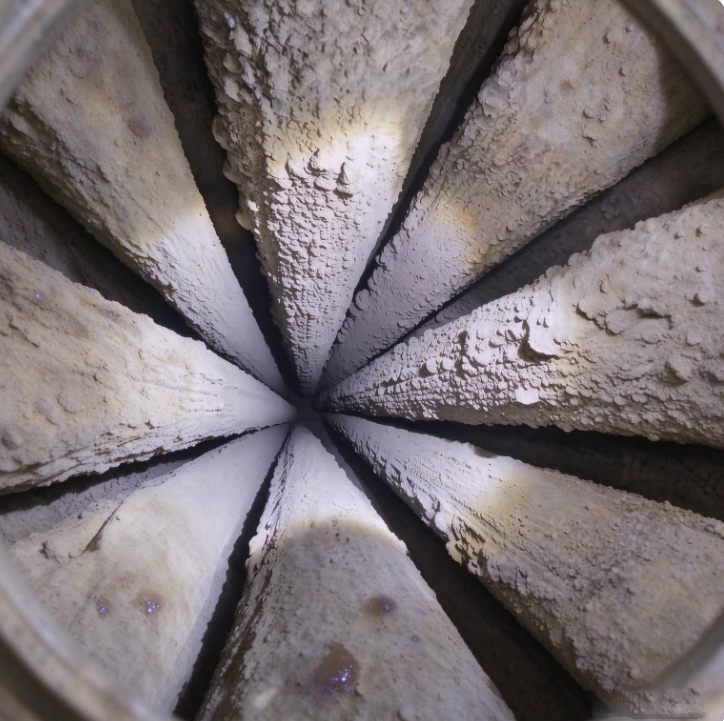
4. Clogging (blinding) of the filter bags: High humidity or the presence of oily dust can cause material to adhere to the filter media, forming a hardened, solid layer—this is what is truly meant by "bag blinding."
II. How Does "Filter Bag Blinding" Occur?
"Filter bag blinding" refers to a condition where dust—combined with high-moisture or oily substances—forms a hard crust on the surface or within the interior of a filter bag. This crust cannot be dislodged by standard pulse-jet cleaning, leading to a continuously rising pressure differential and a sharp drop in suction capacity.
Three common scenarios:
Condensation: When flue gas temperature falls below the dew point, moisture condenses on the bag surface and binds with dust to form a sludge-like layer (frequently observed during the shutdown periods of boilers or drying operations).
Oily/Sticky Dust: In processes involving welding fumes or oil mists, oil components cause dust to adhere firmly to the filter media.
Drying or High-Moisture Processes: Operations characterized by inherently high humidity, often exacerbated by a lack of thermal insulation or heating.
III. Dust emissions from the outlet do not necessarily mean a broken filter bag
When a chimney suddenly begins emitting dust continuously, the immediate assumption is often that a "filter bag has broken." However, there are several other potential causes:
Filter bag damage or detachment (e.g., the bag collar is not properly secured, or the bottom of the bag has worn through).
Poor sealing between the tube sheet and the filter bags, allowing dust to bypass the filtration layer entirely.
Air leaks in the dust collector housing, which reduce negative pressure and cause dust to be drawn out before it can settle.
Troubleshooting tip: Observe the timing of the dust emissions in relation to the operation of the pulse valves. If dust emissions spike whenever a specific valve activates, the issue likely lies with the corresponding row of filter bags, allowing for precise identification.
IV. Four key points for daily maintenance
1.Regulate the inlet dust concentration and filtration velocity to prevent the equipment from becoming overloaded.
2.In operating environments involving moisture or oil mist, ensure proper insulation of ducts and equipment to prevent condensation.
3.Regularly check the operation of pulse valves, pulse-jet pressure, and the efficiency of the dust discharge system.
4.Filter bags and filter cartridges are consumables; replace them promptly when they reach the end of their service life or become damaged—do not wait until emissions exceed regulatory limits.
V. Q&A: Frequently asked questions from clients
Q1: The pressure differential remains high and cannot be reduced despite cleaning; must the filter bags be replaced? A: Not necessarily. First, check for issues such as condensation causing "blinding" (clogging) of the bags, insufficient pulse-jet pressure or air volume, or dust that is excessively fine or sticky. Replacement should only be considered if the filter media has become caked/hardened or has degraded due to age. Before replacing, evaluate the specific operating conditions to determine the appropriate type of filter media (e.g., PTFE-laminated, anti-static, or high-temperature resistant)—do not purchase replacements blindly.
Q2: What are the differences in daily maintenance between bag-type dust collectors and cartridge-type dust collectors? A: Filter cartridges offer a large filtration area with a small footprint, but they are more sensitive to oily or high-humidity dust; for these, the quality of the membrane coating is critical to both service life and cleaning efficiency. Filter bags, by contrast, are more wear-resistant and better suited for high-temperature, high-concentration operating conditions. In both cases, the core of maintenance lies in "preventing condensation, avoiding dust caking, and ensuring effective dust removal."
Q3: How often should filter bags be replaced, and how do you know when it’s time? A: There is no fixed service life; instead, look for three indicators: ① physical damage resulting in dust leakage; ② a persistent pressure differential that remains high even after cleaning; and ③ failure to meet emission standards. Service life depends primarily on operating conditions (temperature, humidity, and the abrasiveness of the dust) as well as the quality of the filter media, typically ranging from several months to several years.
Q4: What precautions should be taken when restarting a dust collector after a shutdown? A: Before shutting down, ensure the filter bag surfaces are thoroughly cleaned and the dust hoppers are completely emptied. Before restarting, run the pulse-jet cleaning system while the unit is empty (without process gas) to verify it is functioning correctly; only then should the flue gas be introduced. This helps prevent "blinding" (clogging) of the bags caused by condensation.
Xinxiang Lefilter Filter Co., Ltd All rights reserved Record No. : 11005909-1 prepared by Yu ICP





