
Home > INDUSTRIES > Solution >
In the cement production process, dust is generated at virtually every stage—from the crushing, conveying, and grinding of raw materials to the final packaging and warehousing of the finished product. If this dust is not effectively collected, it can compromise the workshop environment, impair equipment operation, and pose risks to the occupational health of employees. Furthermore, it can lead to the waste of raw materials and increase the burden of environmental compliance for the enterprise.
For cement plants, dust collection equipment is not necessarily better simply because it is larger or has a higher filtration air volume; the key lies in selecting the appropriate type of dust collector based on the specific characteristics of each dust-generation point.
Among the various types of industrial dust collection equipment, the standalone pulse-jet bag filter—noted for its compact structure, flexible installation, convenient dust-cleaning mechanism, and relatively simple maintenance—is widely used across multiple dust-generating stages in cement plants. This article provides an analysis covering its working principle, technical parameters, and practical application scenarios.
I. What types of dust collectors are commonly used in cement plants?
Different production stages in a cement plant vary in terms of dust concentration, air volume, temperature, and requirements for continuous operation; consequently, the dust collection equipment used also varies.
Common types of dust collection equipment include:
1. Pulse-jet fabric filter (baghouse): Uses filter bags to capture dust, with cleaning performed via pulses of compressed air. It is suitable for a wide range of dust collection applications in cement production.
2. Electrostatic precipitator (ESP): Utilizes a high-voltage electric field to charge dust particles, causing them to deposit onto collection electrodes. These are typically used in flue gas treatment systems for large-scale cement kiln inlets and outlets.
3. Cyclone dust collector: Employs centrifugal force to separate larger dust particles. It generally serves as a pre-dust collection device but can also be used in specific process scenarios.
4. Standalone pulse-jet dust collector: A compact version of the pulse-jet fabric filter, designed for dust collection at isolated dust-generating points or for smaller pieces of equipment.
It should be noted that standalone pulse-jet dust collectors and large-scale, centralized baghouse systems are not interchangeable. The former is better suited for dispersed, low-airflow dust sources, while the latter is designed for large-scale, centralized, and continuous dust collection operations.
II. Working Principle of the Standalone Pulse-Jet Dust Collector
A standalone pulse-jet dust collector primarily consists of a housing, filter bags, filter cages, a pulse-jet cleaning system, a dust hopper, a dust discharge mechanism, a fan, and a control system.
Its operation is straightforward:
Step 1: Dust-laden gas enters the equipment.
Driven by the negative pressure generated by the fan, dust-laden air enters the dust collector through suction hoods and ductwork. Larger particles may settle as the airflow velocity decreases, while finer dust enters the filtration zone containing the filter bags.
Step 2: Dust filtration by filter bags.
As the dust-laden gas passes through the filter bags, dust is trapped on their outer surfaces. The cleaned gas permeates the filter media, enters the clean-air chamber, and is subsequently exhausted by the fan.
Step 3: Pulse-jet cleaning.
As dust accumulates, the resistance across the filter bags gradually increases. Based on preset time intervals or pressure differential thresholds, the control system triggers the pulse valves. Compressed air is then injected into the filter bags via blow tubes, causing them to expand and vibrate, which dislodges the accumulated dust.
Step 4: Dust collection.
The dislodged dust falls into the dust hopper and is removed via a discharge valve or another dust-removal mechanism, facilitating subsequent recovery, reuse, or centralized disposal.
This cleaning method allows for the cleaning of filter bags while the equipment is in operation, thereby reducing the need for frequent shutdowns for maintenance.
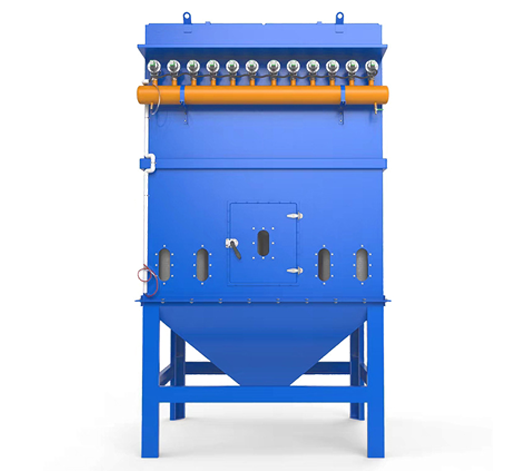
III. Primary Application Scenarios for Standalone Pulse-Jet Dust Collectors in Cement Plants
Dust in cement plants primarily originates from processes such as material dropping, mechanical conveying, grinding, storage, and packaging. Standalone pulse-jet dust collectors are well-suited for the following scenarios:
1. Crushing and Conveying of Cement Raw Materials
After raw materials like limestone and clay are crushed, they must be transported via equipment such as belt conveyors or bucket elevators. Dust is easily generated during material discharge and transfer.
Enclosed dust-collection hoods can be installed at transfer points or discharge chutes of belt conveyors, paired with standalone pulse-jet dust collectors to capture airborne dust promptly and prevent it from spreading throughout the workshop.
2. Cement Grinding and Separator Equipment
Significant amounts of fine dust are generated during cement grinding, separation, and material transport. For individual, small-scale equipment or localized dust-generation points, standalone dust collectors can be configured based on the specific airflow requirements.
It should be noted that the main exhaust systems for cement mills typically involve high airflow volumes and complex operating conditions; therefore, they generally require specialized, centralized baghouse dust collection systems rather than simple, standalone units.
3. Cement Storage Silos and Hoppers
When cement is pneumatically conveyed into a storage silo, the air displaced from the silo carries a large quantity of dust. A small pulse-jet dust collector can be installed on the silo roof to filter the dust-laden exhaust air.
This configuration offers advantages such as centralized installation, shorter ductwork, and the ability to easily return captured dust to the silo. The specific equipment should be selected based on the material-feeding method, exhaust volume, and internal silo pressure.
4. Cement Packaging and Loading
Dust can easily escape during cement packaging or when loading bulk cement. By using suction hoods connected to standalone pulse-jet dust collectors, dust generated during these processes can be captured locally.
For packaging machines with multiple dust-generation points, a multi-point centralized collection scheme may also be implemented, depending on the required airflow and ductwork layout.
IV. Key Technical Parameters of the Standalone Pulse-Jet Dust Collector
Common models of standalone pulse-jet dust collectors include the DMC24, DMC48, DMC64, DMC80, and DMC96. Specifications—such as filter bag dimensions, filtration area, fan configuration, and air handling capacity—may vary depending on the manufacturer.
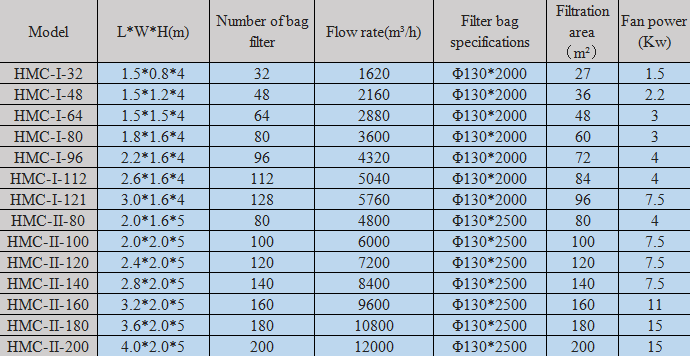
In addition to the parameters mentioned above, cement plants should also focus on the following indicators when selecting equipment:
Filtration Velocity: This directly affects the equipment's filtration load and operating resistance; one should not simply prioritize high airflow volume at the expense of sufficient filtration area.
Filter Bag Material: For standard, ambient-temperature conditions, polyester needle-felt is a suitable choice. In cases involving higher temperatures or specific chemical components, filter media with appropriate heat and corrosion resistance must be selected based on actual operating conditions.
Cleaning Pressure: For typical pulse-jet cleaning systems, the design pressure is generally between 0.4 and 0.6 MPa; however, the specific requirements of the pulse-jet system design should be followed.
Equipment Resistance: This is determined by the filter media, dust characteristics, and the cleaning regimen. The operating status of the filter bags can be assessed by monitoring the pressure differential.
Emission Concentration: This must be determined based on the project’s environmental impact assessment (EIA), pollutant discharge permits, and applicable emission standards; it cannot be guaranteed as a fixed value based solely on the equipment model.
V. What should be considered when selecting a standalone pulse-jet dust collector for a cement plant?
Equipment selection should not be based solely on model number or price; the following factors are particularly important:
1. Determine the required airflow volume based on actual dust generation
Assess the operating conditions of the dust-generating equipment, the dimensions of the dust collection hoods, the number of suction inlets, and the resistance within the ductwork before calculating the necessary airflow volume. Insufficient airflow can lead to dust escaping from the collection hoods, while excessive airflow increases both fan energy consumption and capital investment.
2. Select filter media based on dust characteristics
Cement dust is characterized by fine particle size, a tendency to adhere to surfaces, and, in some cases, high humidity. While standard polyester filter media may be suitable for dry, ambient-temperature conditions, environments involving high temperatures, high humidity, or corrosive gases may require membrane-coated, anti-static, or other specialized filter media.
3. Prioritize the quality of compressed air
Pulse-jet dust collectors rely on compressed air for cleaning. If the compressed air contains moisture or oil, it can cause the filter bags to become clogged or the dust to cake, which impairs the cleaning efficiency. Therefore, the air supply system must be equipped with appropriate filtration, moisture-removal, and pressure-stabilization components. 4. Consider Equipment Maintenance and Operating Costs
Filter bags are consumable components; they should be inspected regularly for damage, clogging, or signs of aging. Other components—such as pulse valves, blow tubes, fans, and dust discharge valves—should also be checked to ensure that minor malfunctions do not compromise the operation of the entire dust collection system.
Dust collection in a cement plant is a systematic undertaking. An effective solution requires not only the selection of appropriate equipment but also the sound design of dust hoods, ductwork, fans, filtration systems, and dust discharge mechanisms.
Standalone pulse-jet fabric filter dust collectors are highly effective for applications such as belt conveyors, bucket elevators, silos, packaging machines, and other localized dust-generation points. For facilities with scattered dust sources and moderate airflow requirements, this flexible dust collection approach is an excellent option.
When selecting equipment, it is advisable to provide details such as the type of dust-generating machinery, the characteristics of the dust, the required airflow volume, operating temperatures, and on-site installation conditions. Professional technical personnel should then calculate the necessary filtration area, filtration velocity, and fan parameters to determine the specific model required.
Xinxiang Lefilter Filter Co., Ltd All rights reserved Record No. : 11005909-1 prepared by Yu ICP





